What makes a porta potty ADA accessible?
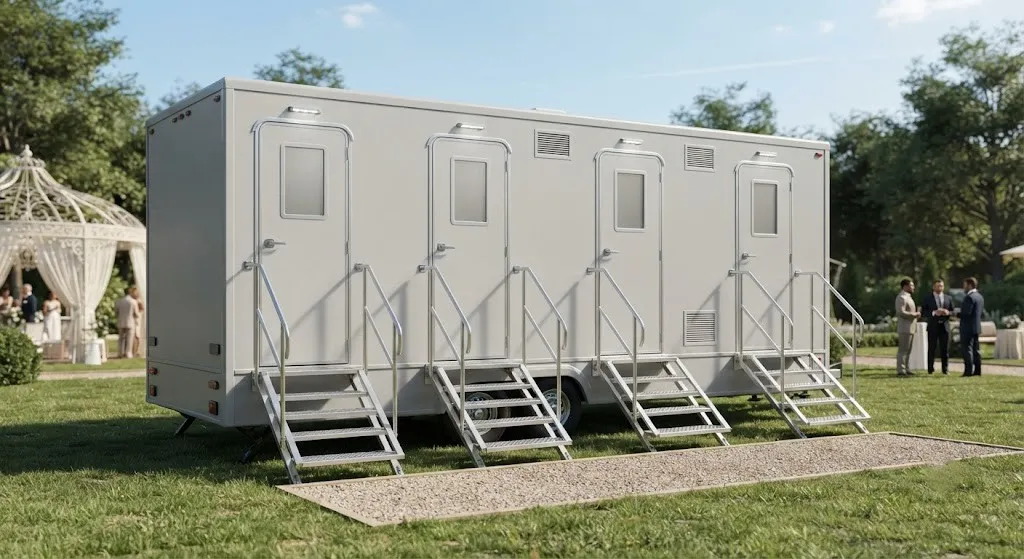
An ADA accessible porta potty is bigger than a standard unit and built around clearance, not just a grab bar. ADA Standards section 304.3.1 calls for a 60 inch diameter turning circle inside, which is why these units run wider and deeper than the standard 44 by 48 inch footprint. The door opening has to clear 32 inches per ADA Standards section 404.2.3, and the path to the unit needs a minimum 36 inch clear width under ADA Standards section 403.5.1. Inside, reach ranges matter too: ADA Standards section 308.2.1 caps a forward reach at 48 inches high and 15 inches low, which is why the paper holder and hand sanitizer sit lower than you'd expect. Door handles and latches fall under ADA Standards section 309.4, meaning no tight grasping or twisting, just a simple push or pull under 5 pounds of force. Brooklyn Park Porta Pros places these units on level, compacted ground because ADA Standards section 302.1 requires stable, firm, slip resistant surfaces, and a unit rocking on soft turf fails that standard fast. If your event has a ramp anywhere in the path of travel, ADA Standards section 405.2 limits the slope to 1:12. Check the porta potty placement guide before you finalize a site plan, and browse the full portable restroom rental lineup if you're still deciding between unit types.
How many ADA units do I need for my Brooklyn Park site?
Start with your total headcount and OSHA 1926.51(c), which sets toilet ratios for construction crews: one unit per 20 workers, then one toilet seat and one urinal per 40 workers once you pass 20, and one per 50 once you hit 200 or more. From that total, ADA Standards section 213.2 requires 5 percent to be accessible units, rounded up, with a floor of one no matter how small the job. A 15-person residential crew still needs one accessible unit even though the math rounds under one. Bigger commercial sites in Brooklyn Park often need multiple ADA units spread across the site rather than clustered at one entrance, especially on jobs stretching several city blocks. For events, the same logic applies: pull your expected attendance, size your total count using the how many porta potties do I need guide, then carve out the accessible percentage. Wedding and festival planners in Brooklyn Park often round up to two ADA units once guest counts pass a few hundred, since one unit serving a long line creates its own bottleneck. Pair that math with the event restroom rental page if you're planning a wedding restroom rental, festival restroom rental or fair-style layout rather than a jobsite, and check county fair restrooms if your event runs closer to that scale.
Do construction sites in Brooklyn Park need ADA units on top of standard toilets?
Yes, if the workforce includes anyone needing accessible facilities, and general contractors increasingly plan for it regardless. OSHA 1926.51(c) sets the baseline toilet count by crew size, and ADA Standards section 213.2 layers the accessible requirement on top of that count rather than replacing it. A site running 25 workers needs its OSHA-driven toilet count plus at least one accessible unit within that total. Brooklyn Park sites near Brooklyn Center, about 3.8 miles southeast, and Champlin, 6.5 miles northwest, follow the same federal standard since ADA compliance doesn't change by city line. What does vary is placement approval: confirm with the City of Brooklyn Park whether your unit sits in the public right of way, since that placement detail needs local sign-off and isn't something to guess at. Review the OSHA portable toilet requirements page for the full ratio table, and check porta potty permit requirements before delivery day. Renovation crews on a single Brooklyn Park home usually just need one standard porta potty rental unit and one ADA unit if the crew has 20 or fewer people; larger remodels scale up from there, similar to what's outlined on home renovation porta potty, and jobs that stall mid-project can lean on emergency porta potty rental to fill the gap.
What does an ADA unit cost to rent in Brooklyn Park?
| duration | low | typical | high |
|---|---|---|---|
| day | $200 | $230 | $400 |
| week | $120 | $185 | $240 |
Weekend rentals for an ADA unit typically run $199 to $300 based on measured rental data. Pricing depends on rental length, delivery distance and how many units you're bundling together, so check the full porta potty rental cost breakdown or the porta potty rental per day page if you're comparing against a standard unit. Multi-week jobs should look at monthly porta potty rental pricing instead, since day rates add up fast on longer projects. Delivery fees run separately and depend on drive time, so a job near Fridley, roughly 8.3 miles southeast of Brooklyn Park, or Anoka, about 9.3 miles north, may carry a different delivery cost than a job inside city limits. Bundling an ADA unit with several standard units on the same delivery run usually costs less per unit than ordering it alone, since you're only paying one delivery fee across the group, and a porta john rental order for the rest of the crew can ride along on that same trip. For general handwashing setups needed alongside your restrooms, 29 CFR 1910.141(d)(2) requires soap and towels or a hand-drying device, not just sanitizer, which is worth knowing before you order a handwashing station rental or a plain hand sanitizer station rental, and the handwashing requirements page covers the difference in more detail.
Frequently asked questions
Do I need an ADA unit if my event only expects a small crowd?
Yes. ADA Standards section 213.2 sets a floor of one accessible unit regardless of headcount, so even a backyard fundraiser or small crew job needs one on site. Skipping it isn't a gray area under the standard.
Can I rent just one ADA unit without any standard units?
Yes, plenty of small jobs in Brooklyn Park do exactly that. If your total headcount under OSHA 1926.51(c) only calls for one toilet, an ADA-compliant unit satisfies both requirements at once.
Where should an ADA unit be placed on site?
On firm, level ground with a clear 36 inch path per ADA Standards section 403.5.1. Avoid gravel, slopes over 1:12, and grass that turns muddy, since section 302.1 requires a stable, slip-resistant surface.
Does Brooklyn Park require a permit for placing units on a public street?
That depends on placement, and it isn't verified here. Confirm directly with the City of Brooklyn Park whether your location counts as the public right of way before delivery, and see dumpster permit requirements for how a similar approval process works on the roll-off side.
Are ADA units different from the deluxe flushable units?
Yes, they serve different purposes. ADA units focus on clearance and reach ranges, while a deluxe flushable porta potty focuses on flushing and sink features. Some units combine both, worth asking about when you request a quote, and our service areas page lists where we deliver both types.
Next step
Get a delivery date
Tell us the address, the dates and the headcount. We size the order and confirm the route.