How many restrooms does a marathon need?
Start with headcount and course layout, not a flat number. A single start/finish festival area with 500 to 1,000 spectators and runners behaves like an event crowd, and event restroom rental planning applies: OSHA 1926.51(c) sets a baseline of 1 toilet for every 20 workers on a job site, and race organizers use that same ratio as a starting point for public crowds, then add units at aid stations along the route. A 10K with three aid stations needs restrooms at each one, plus a cluster at the finish. Marathons spanning multiple Brooklyn Park neighborhoods need units placed every few miles, not bunched at one end. We size the count against your runner registration and spectator estimate, then place standard porta potty rental units at each cluster point. For a race that also needs a real sink instead of gel sanitizer, a handwashing station rental pairs well with aid station restrooms, since 29 CFR 1910.141(d)(2) requires soap and towels or a hand dryer, not just sanitizer, at any washing facility you provide. Races with wheelchair divisions or adaptive athletes need at least one accessible unit per cluster under ADA Standards section 213.2, which requires 5 percent of clustered single-user toilets to be accessible, never fewer than one. See our ADA accessible porta potty page for unit specs. If your race pulls runners from Brooklyn Center 3.8 miles southeast or Champlin 6.5 miles northwest, plan for parking-lot staging and confirm placement doesn't block a fire lane or accessible route, which needs a 36 inch clear width under ADA Standards section 403.5.1.
What does race restroom placement cost?
Pricing depends on unit count, event length and whether you need standard units or something nicer for a VIP or finish-line area. Race weekends usually run Friday setup through Sunday teardown, so weekend pricing applies more often than a single day rate.
| unit | day | week | weekend |
|---|---|---|---|
| standard | $100-$350 | $130-$500 | $125-$400 |
| deluxe | $85-$1,200 | $150-$290 | n/a |
| ada | $200-$400 | $185-$240 | $199-$300 |
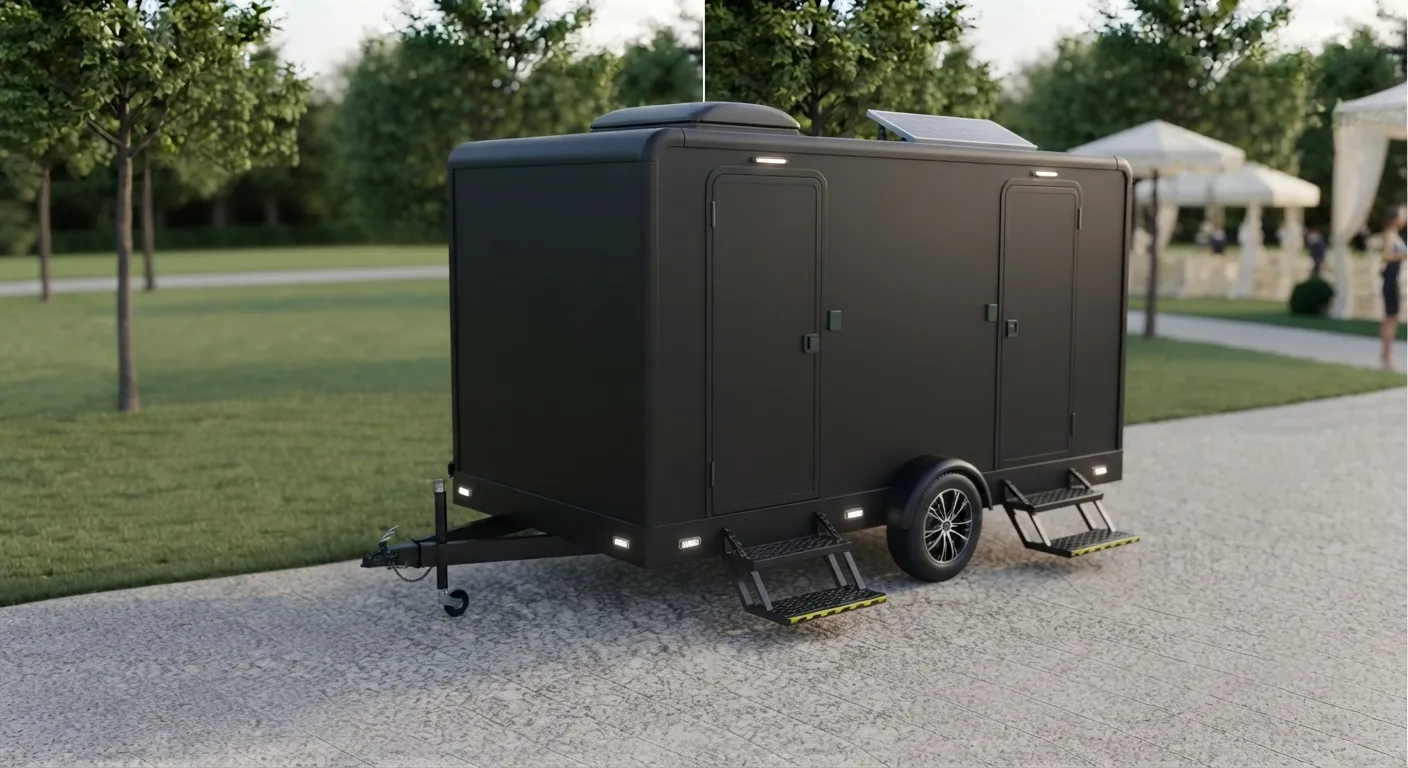
Delivery adds a fee on top of the unit rate, and most race organizers pay a weekend delivery charge rather than a daily one since the units sit for the full event window. Check porta potty rental cost for a fuller cost breakdown, or porta potty rental per day if your race is a single-day event. A finish line VIP tent or a sponsor hospitality area sometimes calls for a deluxe flushable porta potty instead of a standard unit. For multi-day festivals built around the race weekend, a restroom trailer rental or a 2 stall restroom trailer handles higher traffic better than a bank of standalone units, and a luxury restroom trailer works for a title sponsor area. Ask about temporary fence rental too, since race courses often need crowd control barrier rental at the start chute and finish line to keep spectators off the running lane.
How do you power lighting and stations along the course?
Early morning marathons start before sunrise, so aid stations and restroom clusters near the start line often need lighting. A light tower rental covers a staging area well, and if your event needs powered equipment beyond battery-run lights, a temporary power pole supplies power to a timing tent or a sound system. Here's how to brace a temporary power pole for a race: guy it at two or three points with stakes set well outside the runner lane, and never let the cable run cross a route where runners or wheelchairs will pass. Keep the pole's footing on stable, firm ground, consistent with the same slip-resistant surface standard ADA Standards section 302.1 sets for accessible routes, since race volunteers and athletes both cross that ground. If your course runs near Fridley, 8.3 miles southeast of Brooklyn Park, or up toward Anoka, 9.3 miles north, confirm any power pole or generator placement clears the sidewalk and accessible route the same way a restroom cluster would. For race committees running multi-year events, our service areas page covers coverage across Brooklyn Park, MN and nearby towns, and request a quote gets a placement plan started before race day logistics lock in.
Frequently asked questions
How far in advance should we book race restrooms?
Book as soon as your course map and headcount are set, ideally weeks out for a race with more than a few hundred runners. Weekend demand runs high across Brooklyn Park. Contact us through contact or request a quote once your aid station count is final.
Do we need ADA units at every aid station?
Yes, at least one accessible unit per cluster. ADA Standards section 213.2 requires 5 percent of clustered units to be accessible, never fewer than one, so every aid station restroom bank needs its own accessible unit, not just the start line.
Can restroom trailers work for a finish-line festival?
Yes. A 4 stall restroom trailer or 8 stall restroom trailer handles finish-line crowds better than standalone units when runners and spectators converge at once. See restroom trailer rental cost for pricing by trailer size.
What if our race adds a 5K the morning after the marathon?
Multi-day races often keep units in place across both days rather than paying separate delivery fees twice. Ask about weekend or short-week pricing instead of daily rates; see porta john rental for standard unit options that stretch across a full event weekend.
Do aid stations need handwashing stations too?
Yes, especially where volunteers handle food or drinks. Pair a portable sink rental with restroom clusters at any aid station serving food, since 29 CFR 1910.141(d)(2) requires actual soap and towels, not sanitizer alone.
Next step
Get a delivery date
Tell us the address, the dates and the headcount. We size the order and confirm the route.